
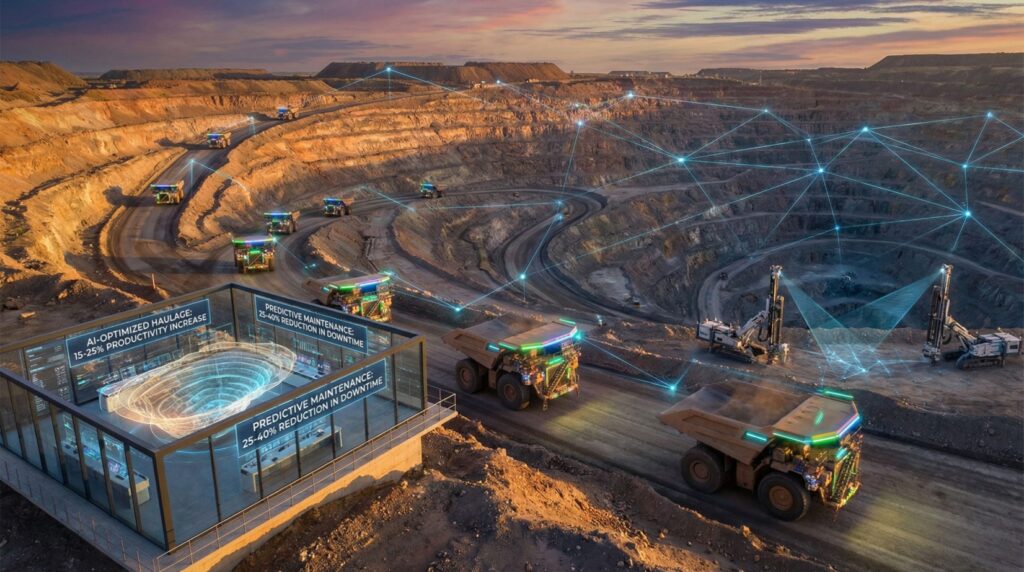
The relentless pressure to boost productivity without compromising on mining safety hinges on the Global Navigation Satellite System (GNSS).
From autonomous haulage systems to high-precision machine guidance on excavators and dozers, most operations rely on a constant stream of accurate positioning data of their mobile assets.
Unreliable positioning, lost RTK lock, and intermittent data can prevent mobile equipment from operating efficiently, such as the accurate movement of autonomous haulers as they park under the dig unit. Inconsistent localization can also add to ambiguous positioning of vehicles, and therefore, material tracking which makes mine operations less efficient than it needs to be.
With the prevalence of GNSS-only, often tablet-based fleet management solutions or automatic dispatching solutions, their reliance on the older, but dominant dual-band (L1/L2) technology could be the limiting factor in achieving the next level of operational efficiency. This is because even with RTK corrections, the traditional approach for a cost-conscious FMS was to use dual-band GNSS receivers, however, these are proving to be a more fragile solution within the dynamics of a complex mine site. Given that all-band GNSS has previously been reserved to only the highest performance, survey-grade receivers, they were deemed not worth the cost of entry.
This is where the power of an all-band enabled GNSS/INS can be the key to delivering fleet management efficiency. By combining our existing, mature INS technology with the latest, yet cost effective all-band GNSS technology, operations can benefit from both improved GNSS performance, while also gaining access to the much needed vehicle motion and orientation information in real-time.

